Kongress Tag Drei
I have been avoiding using an acronym for the Kongress because I don’t want to initiate any association with something that might send you to the toilet.
This being the fourth morning of waking up on the continent of Europe I think I have made it past the jet lag. The mornings have felt rough but long days at the Kongress and the walking have helped as well as the Tamazapan every night. Tonight will be the first night that I will go without so I will see how that goes. It was the first morning I was tempted to skip out on the first session but overcame that and scuttled my butt over to the Missionstrasse albeit a little late for devotions.
The first session was presented by an Englishwoman and was interesting in her suggestion of “slow-ethics” ala’ “slow food”. She began by claiming responsibility for the ecological destruction wrought by a large iron ore mine in southern Africa. This set me off on a parallel thought while she was presenting of my grandpa as a human-rights activist. His response to the death of his father in an iron ore mine in Ely and the circumstances into which his family was thrown as a result was to set off to organize for the workers of this world. To keep more from dying. That is my description of it anyhow. I am sure human rights was not the preferred nomenclature for his activities but perhaps it was part of the lexicon of the movement. I don’t know. I will have to find that out. I had not had the thought of him as such before and am thankful to this Englishwoman’s presentation for sending me down that journey of thought.
I did skip out on the next of the morning sessions as it was to be presented in German and I was at my limit profound thought communicated through a polite translation. So I went for a walk about around the old part of the city. Walking about cities is one of my favorite parts of travel. I think I really caught that bug when I visited Jerusalem and it’s old city twenty years ago. The exploration and adventure of finding your way around and discovering odd places and unique things is inspiring to me for whatever reason. Basel’s old city was great because it is so old and mostly untouched by war and destruction. The location dates back to the Celts settling and then became a Roman outpost. It’s location as a hill on the Rhine aided in its development as a significant spot. It suffered an earthquake in the 11th or 12th century that necessitated the rebuilding of the Munster with the red sandstone that makes it so striking. But other than that it was not bombed or destroyed in the two world wars nor did the structures suffer in previous wars, although the people may have.
The walk about led me down to and across the Rhine. As you can see the Basel Munster sits above the flowing waters.
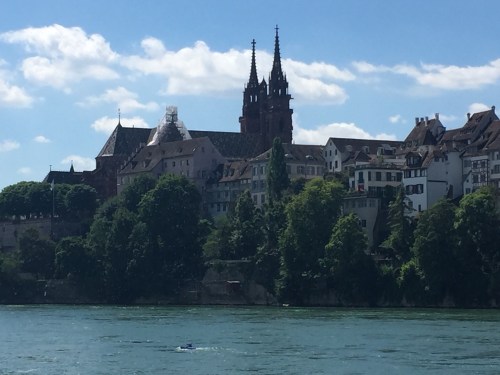
People love to float down the Rhine and sometimes even swim across it. It is a big enough activity that they make special bags for it. They are essentially big dry bags that you put all your clothes into along with a fair bit of the atmosphere and then seal with the folds and the clip. Then you jump in. With the current moving like it does you will surely end up somewhere much farther down the river so having your clothes with you is appreciated. And with the bag acting as a bouy you needn’t swim and are visible in the water. I wanted to have a go at it but timing and being alone I felt it to be a bit too much to go after.
I cut up a narrow street that was obviously very old as it was not concerned with appropriate grade or modern ordinances.
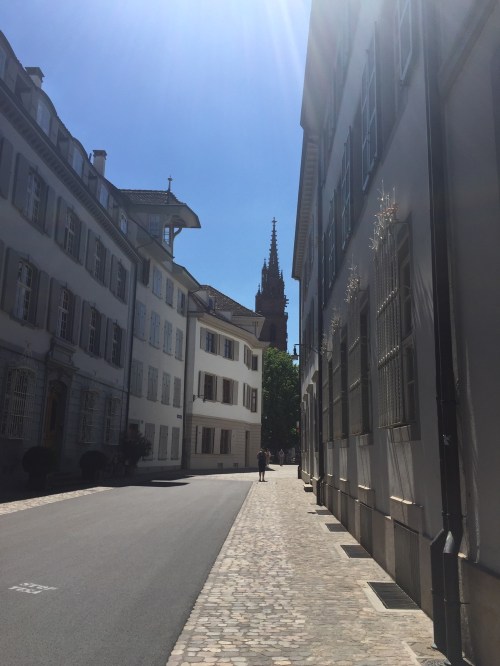
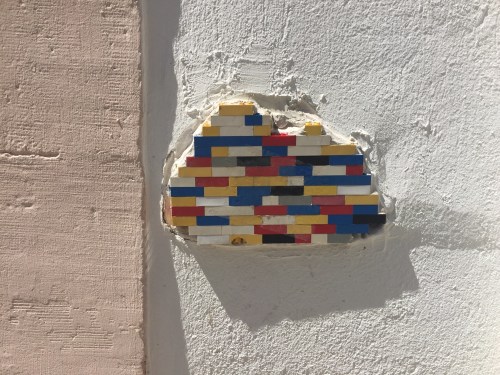
I cut off of that street up another towards a fountain I saw and ended up very excited to have done so. The street with the fountain was deserted but I continued down it and noticed some Legos built into the wall at one point.
A few weeks ago Paavo, Tuuli and I had watched the Lego Brickomentary and this little movement of filling in holes in walls with Legos was documented as happening all over the world. And here it was. Needless to say, I am excited to share it with Paavo and Tuuli.
I finished the walk about in time for lunch back at Missionstrasse 21. I went to the first part of a session after that but then ducked out so I could go on a tour of Karl Barth’s house. This may seems like a strange activity to some but bear with me and call me strange afterwards.
I caught a taxi over to a different part of the city with Luis, who was from outside of Rio de Janiero, Brasil and had been coming to the Kongresses for some years and was part of organizing this one. He was in a wheelchair so the organizers called him a taxi and so I went with to help him with the stairs and such. As was evident later on our way back on the Tram he needed neither the taxi nor all the help we were intent on giving him getting on and off Trams. I suppose if you navigate Rio in a wheelchair Switzerland isn’t much. But we all tried nonetheless.
Karl Barth was a seminal systematic theologian of the 20th century. He was the last theologian to create a systematic theology- which is to say he accounted for every dogmatic angle of life in this world and the role of God in it. A crude description but these were complete theologies that would take years to complete and they would fill volumes. I think Barth’s Christian Dogmatics had eight volumes. It was a practice for theologians going to back to the Middle Ages if they could accomplish it. It’s never been done in America (your wondering why someone would do such a thing is probably why) except for Paul Tillich who started his while he was still living in Germany before the war. Anyway, we don’t do it any more because we no longer think God has much of a role in the world or if we think that God does have a role we don’t really want think through the details of it.
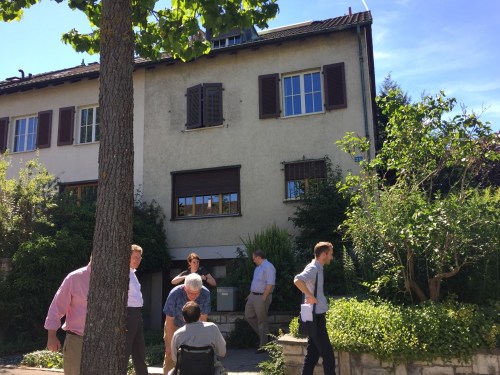
So Barth has been the most influential of systematic theologians in recent times (he was even on the cover of Time magazine) and wrote many of his works in this house in Basel. Hard for a guy like me not to visit. The house was unremarkable, nothing special.
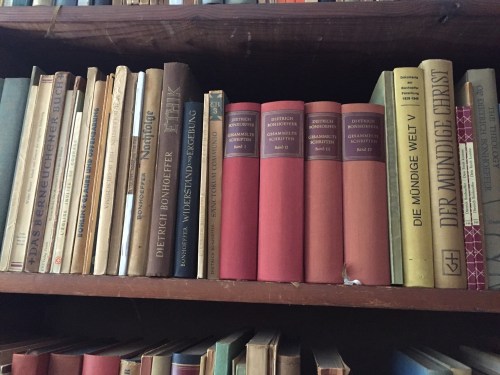
His study was most interesting with the walls filled with books as one might expect. The were two rooms adjacent to each other that defined the study. His library was filled mostly with theology, history, biblical studies, with one shelf devoted entirely to Mozart that was within easy reach of the reading chairs.
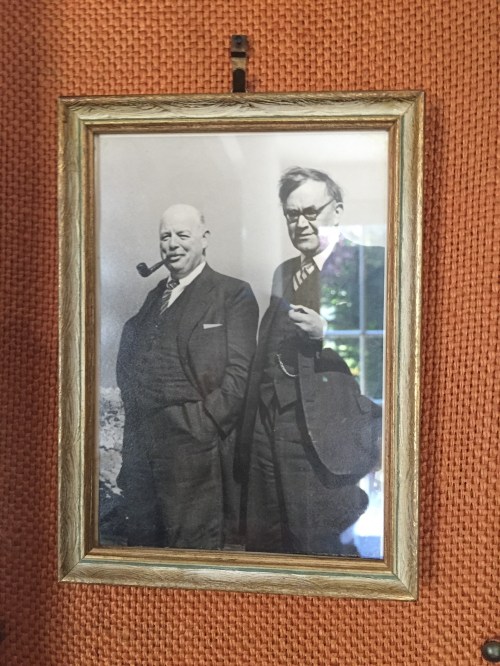
Here is Barth (right) with his publisher and friend.
Barth had a relationship to Bonhoeffer and the younger German visited the older Swiss in the Thirties. Bonhoeffer was greatly influenced by Barth although he was never considered a Barthian. That visit is one of the reasons this Kongress was held in Basel. Most every Kongress has been held in a city in which Bonhoeffer had a connection during his life. The exceptions I know of were Prague and South Africa but his theology held a large influence in those spots so it was appropriate. A local good organizing committee helps, as well. The next Kongress will be back in South Africa, again due to his large influence in the Apartheid movement. As one participant told me, as Bonhoeffer’s writings were passed around the circles of that struggle they often came with no titles or author mentioned. Most of those readers thought the writer was a living member of their struggle.
Barth later claimed Bonhoeffer’s Dissertation Sanctorum Communio, which he wrote at age 21, to be a theological miracle. I found Bonhoeffer’s works from that time in Barth’s collection.
Enough about Barth, for a moment anyway. We returned in time for a last session and then a dinner that we lingered over because of the beautiful evening. Later that evening the Karl Barth award was award was handed out in conjunction with our conference to a fellow with three Dr.’s in front of his name. He seemed a deserving candidate for such a distinguished award but what do I really know. It was all in German. That was followed by champagne in the courtyard and another late night walk back to my bedroom.

Int. Bon. Soc. Zwei
The second day was like the first with its schedule. Two long sessions in the morning with a coffee break followed by lunch. And then three shorter sessions with a coffee break followed by dinner. It made for full days with dinner not finishing until after 7:00 if you were enjoying your dinner conversation.
The meals and the coffee breaks played the wonderful role of having the opportunity to talk and build relationships as they weren’t abbreviated. Coffee breaks were half-an-hour and lunch was an hour-and-forty-five minutes. Coming right after the sessions they also provided further discussion time. And for those deep into the academic world it provided rare face-to-face time with important colleagues. But it was most important as a time to relate, meet new people from around the world and to continue friendships that, for some, stretch over the 40 years ago of these Kongresses.
But as someone new to Kongress it can be a bit intimidating. Initially I am more reserved in such social times considering I don’t hold a position anywhere, I haven’t been published (mostly true) and I hold no degree beyond a lowly Masters. And these factors are the currency of introductions. Thus my narrative in response to the introductory queries could be quite short in comparison to others. So I went with the shorten-it-even-further tack to dislodge the routine conversation. As in: The Other, “And what do you?”; Me, “Nothing.” I’ve found it not only dislodges routine conversation but also sifts through people quicker in finding those whose interests are more than whether I may be of use to them. Pleasantly there were a lot less of those folks at the gathering than others I’ve attended. While networking is not always a bad thing for further work together the common interest in the other for who they are was the common currency of interactions at this gathering. That idea as being a core part of Bonhoeffer’s theology probably created this currency. All of this is to say is that coffee and meals were more enjoyable than they could’ve been. But if I just said that you’d be done with the pictures by now.
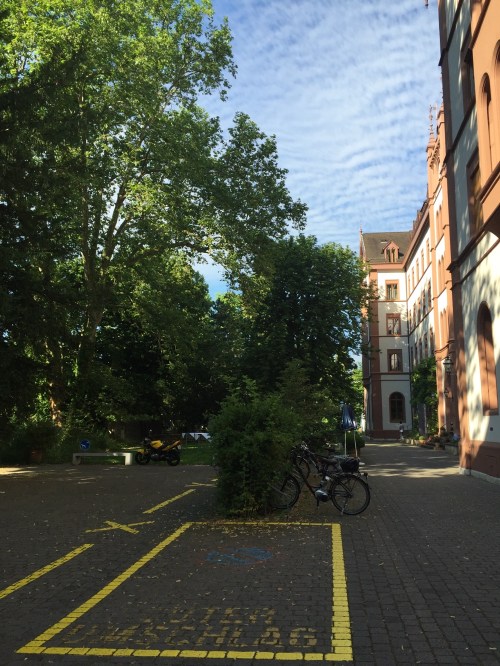
The only picture I have of the courtyard with gathering area hidden behind the bike and shrubs. There was also a beautifully large garden at the far end.
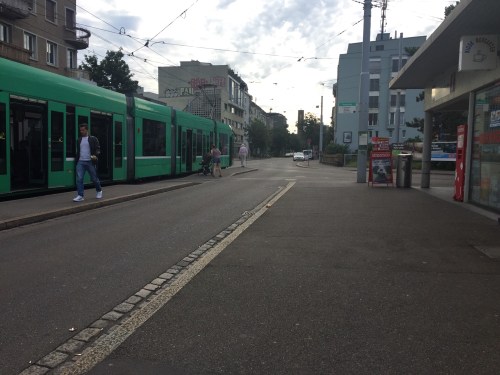
The beginning of the 10-minute walk from my Airbnb.
Friday evening I caught a tour to the Basel Munster, the iconic church of the city to see an Erasmus exihibit. This year is the 500th anniversary of first published Greek New Testament, translated at the hand of Erasmus. This was significant because until that publication there was no complete collection of the Greek New Testament (the language in which it was written) and it certainly wasn’t available to anyone for study unless you traveled to the various locations where different recovered Greek manuscripts were kept. What was available was the Latin translation of the New Testament. This was used in the Mass but was insufficient for good translation into other languages. So Erasmus’ publication enabled a new wave of translations into other languages and thus unintentionally contributed to the efforts of the reformation movement.
At Basel Munster were some of the original texts from that process. It also is Erasmus’ final resting spot. His headstone sits off of the main sanctuary of the church.
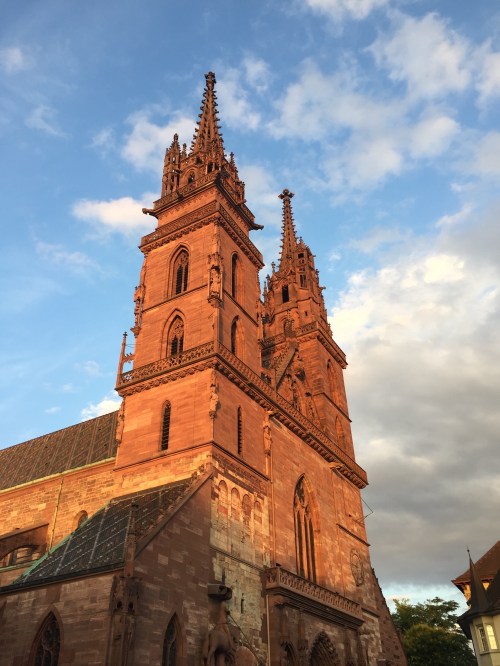
Basel Munster
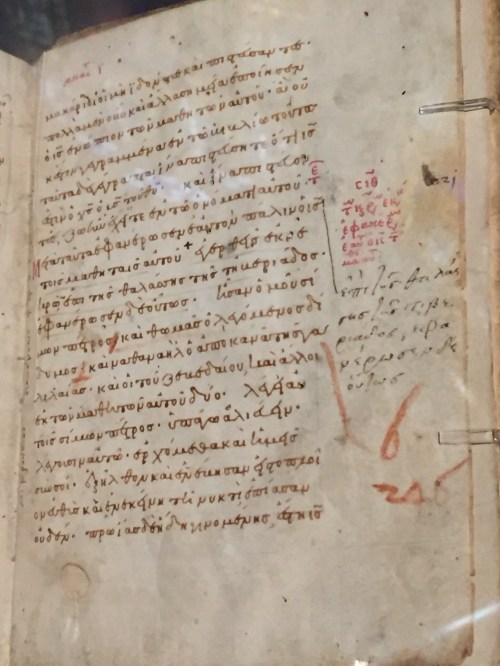
Original annotations of Eramus’. His handwriting is in black on the side under the red.
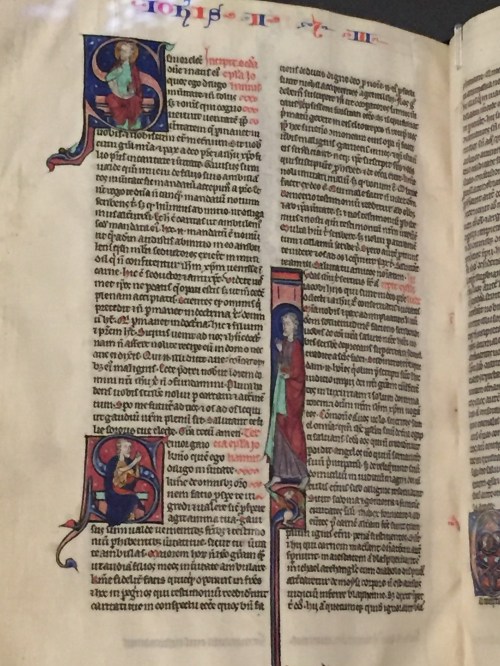
Beautiful art within a Latin text.
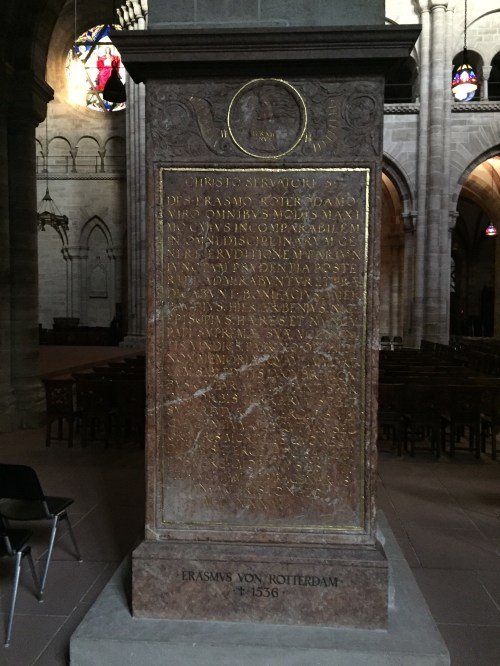
Erasmus’ headstone.
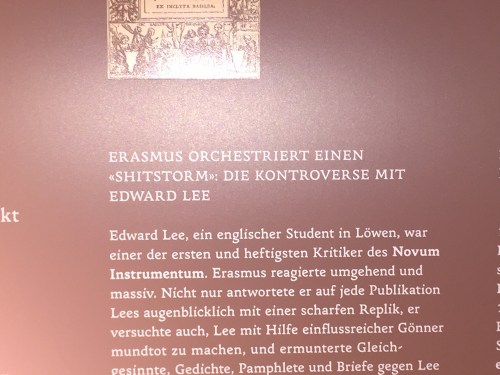
“Erasmus orchestrates a Shitstorm” is the headline from 500 years ago. He orchestrated an even bigger shitstorm with his published arguments with Martin Luther in the 1520’s concerning the Bondage of the Will. This was a seminal argument in the Reformation. Luther won the argument but lost the war as is evidenced in our theology today. I recommend any investigation into that argument amongst giants.
. . . travel . . .
Perhaps I shouldn’t have been so celebratory of my smooth intinerary. After sitting in the SAS lounge and retruning to Oslo for a walkabout I made it back to my gate at Gardermoen only to have that flight delayed. It was the 200 K/ph headwind for the inbound flight that set us back. The return flight would have a corresponding tailwind though (turned out to be 220, or 136 mph) so the pilot was optimistic about an ontime arrival until some fellow didn’t show up and they had to rummage through the luggage compartment to find his luggage. I was hoping for an ontime arrival as I had a train to catch to Basel from Zurich which would deliver me to my Airbnb around midnight. The search for baggage put me on a Swiss train an hour later than hoped for and without my checked bag. Turns out that keeping a bag with it’s passenger isn’t as necessary as their under-planning rummaging suggests. I arrived at the Basel train station at 12:30 am and tried to figure which tram was needed to bring me to my accomadation. And if it was running at that time. After a bit of wandering/figuring I finally smartened up and took a taxi to the address, found the hidden and descended the stairs to my waiting bed, about twelve hours after planned. There goes my Swiss timing.
Travel
Air travel for me, of late, has been a story of delays. And that is not hyperbole. I have kept track going back more than seven years and not once have I completed an air travel itinerary without a delay or obstruction. The delays and cancellations have been due to the frequent thunder storms, snowstorms, fog, overbooking and the less frequent pilot’s seats that don’t swivel, the unexplained (where conveniently the later plane we were delayed to had just enough seats for both flights) and once a pilot simply did not show up. The airlines have varied from Delta, Westjet, Porter, SAS, KLM, and Alaska Airlines (the most frequent contributor to my airline woes). And they have spanned including Thunder Bay, Toronto, NYC, Montreal, Lexington, Seattle, Kelowna, Chicago, Calgary, Stockholm, Amsterdam, Helsinki, Copenhagen, Minneapolis/St. Paul, Duluth and once being sent to Edmonton instead Seattle for what seemed to for kicks and giggles (I got a pair of nice wool underwear out that one courtesy of Westjet even though it was Alaska that lost my lugagge). To sum up, I travel the skies with the expectation of delay because I have known nothing else for almost a decade (no exaggeration).
My intinerary for this trip from Duluth to Oslo had me on an Airport Shuttle (10 people in a 10 passenger van) from the DECC in Duluth to Terminal 2 (old Humphrey Terminal) at MSP followed by an Icelandair flight to Keflavik (Reykjavik’s airport) and a flight to Oslo. I was looking forward to the shorter trans-Atlantic flight (under 6 hours to Keflavik) and the seeming easier transfer in there. And then it happened. I was in Oslo exactly when I had planned to be there. No delays except for the extra minutes the immigration woman took to make sure I was who I claimed to be (I looked different than my passport photo, she said. I’ll take it as a compliment as we all know how passport photos turn out). I was happy to experience a seamless itinerary and very tired from not having slept on the flight. I stumbled around Gardermoen (Oslo Airport) and the train station and made it to Joel and Emily’s apartment (my brother and sister-in-law). There I took a quick nap and then went for a walk-about to reacquaint myself with Oslo as well as to ward off sleep. For waking up in Duluth and going to sleep in Oslo it was a good day of traveling.
But I won’t let it go to my head. I am writing this from the SAS lounge in Gardermoen. My flight was overbooked and I was bumped. I’ll add SwissAir and Zurich to my list.
Interlude
It has been about twenty-two months since the conclusion of my last overseas adventure to Helsinki. It finished up fast and the transition back to a schooltime ritual was quick.
The time between has been uneventful in an event-filled kind of way. Life is good if it is moving on with the meaning that comes from the time you spend with those you love. Having concluded the last post on the day before the first day of school for my then First and Third graders, I now have a Third and Fifth grader starting this Fall. That is two years of life experienced with individuals for whom the world is getting bigger and bigger and life is becoming more complex but for whom cynicism is still a few years away. They are an enjoyable way to spend my living.
I returned from Helsinki twenty-two months ago on Labor Day and am leaving for Oslo and Basel, Switzerland on the Fourth of July. I guess I like to travel on Holidays. The conference I went to Helsinki to be a part of was entitled “Holy Crap” and concerned itself with exploring the intersection of Popular Culture, Technology and the Sacred. The paper I presented was included in a digital journal published afterwards. A link to that journal is here. I haven’t read that paper since I submitted a revision of it and feel it to be incomplete in its intentions. But I was intentionally trying to explore intersections and so it is what it was. Less an academic paper, more a presentation of ideas.
The conference I am heading to now is a bigger gathering with a more specific focus. The International Bonhoeffer Society meets every four years at a Kongress held at different spots around the world. This meeting is being held in Basel, Switzerland. It is occurring the week before Nancy, Paavo, Tuuli and I are to set out on five-week adventure in Scandanavia. With such timing I was able to travel early to be a part of the Kongress. I have been a member of the International Bonhoeffer Society before and am now again. The schedule for the Kongress looks exciting for Bonhoeffer geeks like me.
So, off I go.
 Apocalypse Then